 Block Paving
 Paving Slabs
 Permeable Paving
 Retaining Walls
 Facing Bricks & Walling
 Kerbs & Edging
 Steps
Steps
0 products added
-
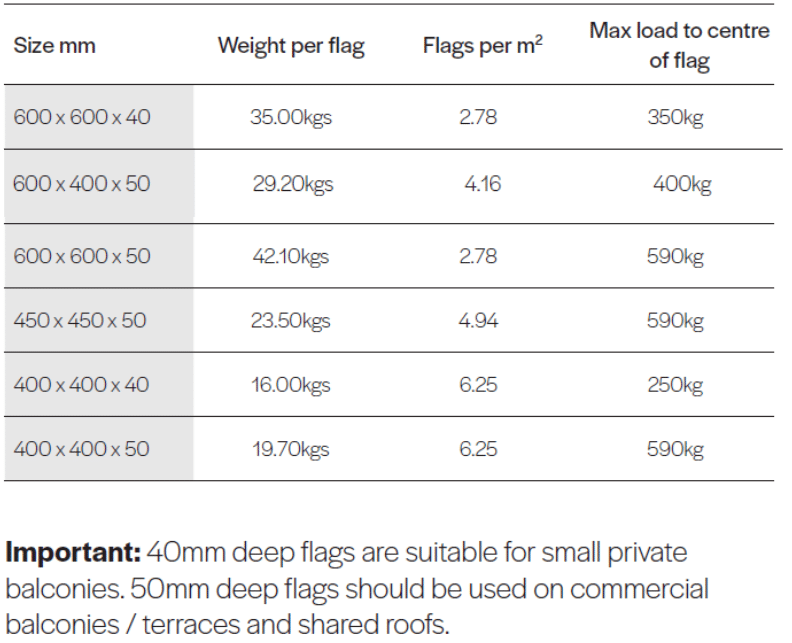
Can I install Tobermore concrete slabs on pedestal supports?
Tobermore slabs can be installed on the vast majority of pedestals offered by the various pedestal manufacturers. For confirmation, please contact the pedestal manufacturer directly.
We recommend the following guidance:


For more information on Tobermore’s roof decks & terrace support and our paving range for pedestals, please access our dedicated roof decks & pedestals brochure.
-
Can I use proprietary bedding, priming and jointing mortars for bound installation?
Yes, proprietary bedding and jointing mortars are now used frequently during bound installation. There are numerous manufacturers of these products which meet and exceed the requirements of BS 7533. For a more detailed breakdown of the benefits of bound and unbound installation, read our blog on bound vs unbound paving.
For more detailed installation guidance, access our bound block paving and bound paving slab installation guides.
-
What are the recommended falls for slab paving?
To ensure surface water runs off the slab surface, a minimum longitudinal fall of 1.25% (1:80) and cross-fall of 2.5% (1:40) should be incorporated.
For more information on the recommended falls for slab paving, navigate to the ‘preparation of sub base’ section of the unbound slab paving installation guidelines.
-
Do you have Declaration of Performance certificates for your products?
Yes, Tobermore offers Declaration of Performance (DoP) certificates for all its products, ensuring we are compliant with the Construction Products Directive. All our performance figures are guaranteed by independant lab testing. To view our DoP certificates, please access the Declaration of Performance certificate downloads on our website.
-
Do you have any responsible sourcing certification for your slabs?
Yes, Tobermore offers certificates of registration for the responsible sourcing of products, namely BES 6001 Framework standard for the responsible sourcing of products and ISO14001 for the following scope: Manufacture, supply and distribution of concrete paving bricks to British Standards. The manufacture and supply of other pre-cast concrete products, paving slabs, flags and kerbs. Procurement and supply of sandstone and granite paving products.
These certificates can be downloaded from the company standards download section on our website.
-
How do I cut concrete slabs?
Once all full size slabs have been laid, use cut slabs to complete the area. Where cut slabs are required, avoid cuts which are less than a quarter of the original plan size. The use of in-board cuts can help to achieve this. Slabs should be cut using a masonry saw with water suppressant. Full PPE must be worn. When 25% of a slab needs to be cut, the remaining piece should be cut from the internal corner of the cut to the external corner of the slab at an angle of 45 degrees.
For more installation guidance on our concrete slab range, please access our unbound slab installation guidelines or bound slab installation guidelines, depending on which laying method you have selected.
-
Can you provide sub base design help?
Yes, Tobermore offers a free, easy-to-use and intuitve online sub base specifier tool. Simply enter a few project details and you’ll receive preliminary sub base design drawings which you can use for your initial design and project pack. To use the tool:1. Select the project type you are working on2. Next, select the product type you’d like to use – block Paving or paving slabs3. Now select which of our products you would like to specify4. Select the depth of the product you’d like to specify5. Now select the product plan size6. Choose the maximum loading category your project will be subject to7. Receive your DWG drawings straight to your inbox -
How wide are the joints in concrete slab paving?
To allow for the slabs’ dimensional tolerances and to create a gap to allow brushing in of kiln dried jointing sand, slabs installed unbound must have joints between 2-5mm.
Important: Straightness of lines is dependent on workmanship and any differences in sizes of the slabs that result from the manufacturers permitted tolerances. Installing the slabs using a 2-5mm joint can help achieve straight lines.
Tobermore do not recommend butt jointing slabs. Butt jointing is when slabs are installed tight together (touching). This will make achieving straight lines more difficult and causes the edges of the slabs to spall.
Slabs installed bound should have joints between 6-10mm.
For more installation guidance on our concrete slab range, please access our unbound slab installation guidelines or bound slab installation guidelines, depending on which laying method you have selected.
-
How do I joint concrete slab paving laid using the bound method?
Mortar Jointing using a trowel:
Joint filling usually occurs 24 hours after the slabs have been laid on the mortar bedding course. Press the mortar firmly into the joints using a trowel. The whole joint should be filled with a compacted mortar to within 2-3mm of the slab surface. Finish the joint using a pointing iron. Extreme care should be taken to avoid staining the slab surface with jointing mortar. Clean any spills immediately using clean water. The strength of jointing mortar required will depend on the application. Please refer to BS 7533:102:2025. As a guide, typically a 1:4 cement/sand mix is used.
Slurry Mortar Jointing: Important:
To avoid staining the surface of the slabs, extreme care should be taken when slurry jointing. Slurry jointing mortars begin to set quickly allowing the paving to be cleaned shortly after jointing is complete. Determining the optimum time to allow the joints to start to set whilst still being able to remove the excess material is crucial. If left too long it will become much more difficult to clean off and there is a risk of staining the slabs permanently. Temperature and humidity will also affect the setting time. On very hot days, it may be best to leave jointing until late afternoon. We would strongly advise to construct a trial panel to determine the time required. Completely soak the entire area of slabs with clean water. A suitable strength mortar slurry should be spread over the area. A squeegee should be used to move the slurry over the surface to ensure all open joints are adequately filled. As much of the excess slurry should be removed from the surface of the slabs and the joints should be allowed to firm up. Once the joints have begun to firm up, any jointing slurry remaining on the surface of the slabs must be washed off carefully taking care not to wash material from the joints. For best results, use a sponge grout roller machine. Alternatively a pressure washer can be used with care.
For a detailed breakdown of how to lay our concrete slabs bound, please access our bound slabs installation guidelines. Unsure which installation method to use? Read our benefits of bound and unbound paving blog.
-
How do I joint concrete slab paving laid using the unbound method?
Concrete slab paving installed unbound is jointed with kiln dried jointing sand. The sand is brushed and vibrated into the joints using a plate compactor.
Important: The paved area should not be cleaned by vacuum road sweepers for a minimum of 3 months. This prevents loss of jointing sand and allows sufficient time for the sand to self-stabilise. If necessary, the jointing sand can be stabilised immediately by using a sand joint sealant.
For a detailed breakdown of how to lay our concrete slabs unbound, please access our unbound slabs installation guidelines. Unsure which installation method to use? Read our benefits of bound and unbound paving blog.
-
What is the recommended bedding / base course for concrete slab paving?
Concrete slab paving can be installed “unbound” on a bed of sharp sand which should be approximately 30mm after final compaction. Concrete slab paving can also be laid “bound” on a bed of mortar which should be approximately 40mm after final compaction. Slabs with plan dimensions greater than 450x450mm are normally laid using the “bound” method.
Tobermore strongly advise against spot bedding as this can cause staining to appear on the surface.
For a detailed breakdown of how to lay our concrete slabs unbound, please access our unbound slabs installation guidelines. Unsure which installation method to use? Read our benefits of bound and unbound paving blog.
-
Does Tobermore have installation guidelines for slabs?
Concrete paving slabs should be installed to BS7533-102:2025.
For more installation guidance on our concrete slab range, please access our unbound slab installation guidelines or bound slab installation guidelines, depending on which laying method you have selected.
Unsure which installation method to use? Read our benefits of bound and unbound paving blog.
-
Are there guidelines regarding the size of cut blocks?
BS 7533 states that a cut block should not be smaller than a quarter of a full-size block. Blocks should be cut using a masonry saw with water suppressant or bench mounted water-cooled power saw to ensure the best appearance of this block, regardless of what laying pattern is chosen by the installer.
Inboard cutting should be used to ensure individual blocks are not cut less than a quarter of the original size. Inboard cutting ensures structural performance by utilising larger cuts as opposed to smaller ones, particularly at the border or edge of a paved space. For installation guides and specification sheets for all our products, please access the downloads section of our website.
-
Can I lay slabs over an existing tarmac or concrete base?
It is better to avoid this if possible. However, it can be done provided the existing base is in good condition, has no cracks and has a fall for drainage. A fall cannot be created in the laying course. It is very important that the finished surface level of the paving remains below the DPC (Damp Proof Course) level.
For more installation guidance on our concrete slab range, please access our unbound slab installation guidelines or bound slab installation guidelines, depending on which laying method you have selected.
Unsure which installation method to use? Read our benefits of bound and unbound paving blog.
-
Can I butt joint slabs?
No, slabs must always have a joint whether they are laid unbound or bound.
Slabs laid unbound will have a 2-5mm joint and slabs laid bound will have a joint width of 6 -10mm. For more installation guidance on our concrete slab range, please access our unbound slab installation guidelines or bound slab installation guidelines, depending on which laying method you have selected.
Unsure which installation method to use? Read our benefits of bound and unbound paving blog.