 Block Paving
 Paving Slabs
 Permeable Paving
 Retaining Walls
 Facing Bricks & Walling
 Kerbs & Edging
 Steps
Steps
0 products added
Products
Back



The growing impact of climate change has become more apparent with the country simultaneously experiencing widespread flooding, habitat loss and a decline in biodiversity. This means housebuilders must build new home developments that are designed to prevent flooding from the outset, while also boosting natural habitats. The good news is there’s a proven way to do this. When undertaken correctly, this can not only increase the development’s appeal to potential homeowners but, contrary to popular belief, be a cost-effective Sustainable Drainage System (SuDS) scheme.
According to the Met Office, rainfall events that would have occurred once every 50 years before the industrial age are now occurring every five years. As a result, managing flash, surface, river and coastal flooding is one of the biggest challenges faced by the UK – with surface water flooding posing the biggest risk due to its unpredictability. The problem is likely to worsen. According to the State of the UK Climate report, the intensity of summer rainfall is increasing, while winters are also getting wetter.

The rainfall rate of a one in 100-year event could approach 300 litres per second. To help you visualise what that looks like, the average bath tap flows at a rate of around half a litre per second. So, the 100-year event equates to 100 bath taps. Given how the urban environment has prioritised the use of hard surfaces that cannot absorb water in both infrastructure and construction projects, it’s no wonder traditional drainage systems become quickly overwhelmed, leading to flash and surface water flooding with devastating results for local homes and businesses.
At the time of writing, the UK’s National Planning Policy Framework requires the use of Sustainable Drainage Systems (SuDS) wherever possible. The anticipated future implementation of Schedule 3 of the Flood and Water Management Act (2010) in England is also a consideration.
SuDS prevent flooding by mimicking natural drainage by slowing the rate of surface water run-off and improving infiltration. They are suitable for use in both rural and urban areas.
In England, developments of 10 dwellings or more (or the non-residential equivalent) are encouraged to include a SuDS scheme unless it’s deemed inappropriate. SuDS schemes are mandatory in Wales on all developments with a construction area over 100m2.
In 2021, to ensure that good practice is embedded into national and local planning policy, the government published the National Model Design Codes with associated Guidance Notes. This includes guidance on 10 different types of SuDS devices to help control surface water where it falls.

Alongside the climate crisis, Britain is also facing a biodiversity crisis. The extent was laid bare in the 2023 State of Nature report. This found that one in six species in the UK is at risk of extinction. This includes plants and animals, though some groups such as birds, amphibians, reptiles, fungi, lichens and terrestrial mammals were at much higher risk. Pollinators were also found to have declined by an average of 18% and just 14% of habitats that are important for wildlife were found to be in good ecological condition. What can be done to change this?
To help combat the decline of natural habitats for wildlife, Biodiversity Net Gains (BNG) became mandatory for all major residential developments of 10 or more dwellings in February ‘24. In April ‘24, this was extended to minor residential developments of under nine dwellings with an area of less than one hectare, or less than 0.5 hectares where the number of properties is unknown.

This requires developers to deliver a BNG of at least 10% (BNG requirement can exceed 10% and in some cases be 15%), ensuring that the final development offers more natural habitat, a better quality of natural habitat, or both, than there was before construction started. In England, BNG is mandatory under Schedule 7A of the Town and Country Planning Act 1990 (as inserted by Schedule 14 of the Environment Act 2021). Habitats must be maintained for a minimum of 30 years.
As well as including guidance on BNG, the National Model Design Codes explain how developers should approach landscape, green infrastructure and biodiversity. The codes state that new developments should contribute towards the creation of a network of green spaces and facilitate access to natural green space where possible. There should be a focus on ecology to ensure that spaces are ‘nature-rich’, and it stresses the importance of ‘tree-lined streets’ in increasing a development’s appeal to people, improving air quality and encouraging walking.


It’s best practice to integrate SuDS throughout the whole development. To this aim, the National Model Design Codes state that SuDS must be considered during the early stages of design. This allows the designer to factor in the natural layout of the site. Trying to retrofit SuDS schemes into existing housing scheme designs, while not impossible, is much harder to achieve. It can be more expensive and mean that creative solutions can be overlooked.
There are four design principles to SuDS. These ask the designer to consider how the quantity of rainwater runoff will be controlled, how the quality of the water will be managed to prevent pollution, what amenities will be created for the people using the spaces and how biodiversity will be improved. These principles are all interlinked and most SuDS schemes will utilise multiple components for maximum effectiveness.

In terms of managing the quantity of rainfall, it’s now becoming the norm for SuDS schemes to ensure that the first five millimetres of rain – that’s equivalent to normal, everyday rainfall – never leaves the site. Well-designed SuDS schemes can accommodate up to 40% of water volume in soil vegetation alone. Where permeable paving schemes are used, the amount of water drained will vary from site to site and is dependent on the type of system used, the infiltration rate and storage system. Flow rates from a development are usually controlled to meet the greenfield runoff rate or at a value agreed with the planners.
However, the SuDS scheme will be able to exceed the 100mm per hour likely to be experienced during an extreme storm in the UK. Design for new developments apply a Climate Change Allowance factor of 1.4 (multiplying current maximum rainfall by 1.4) to account for the projected increase in future.

There can be a tendency to assume that unless a site has a specific topography, then it can’t be used for SuDS. That’s simply not the case. The designer needs to think creatively about how to reduce the volume of water. On most sites, it is better to incorporate a number of flow controls either at source or at site controls throughout the development rather than focusing on utilising one large flow control at the bottom of the site.
It also makes sense to use a combination of SuDS devices such as permeable paving, rain gardens, tree pits and blue/green roofs to create a series of small sub catchments, each of which manages relative volume and quality of the water.
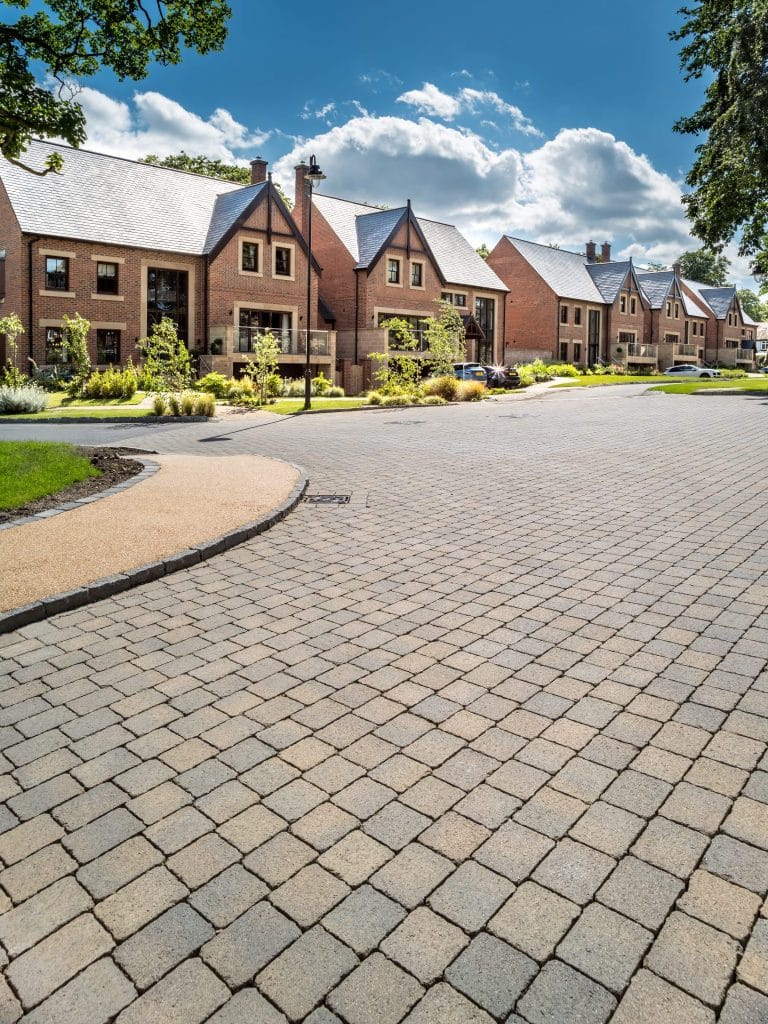
Permeable paving prevents surface water flooding by allowing rainwater to infiltrate through the paving. It can either drain directly into the ground or is attenuated and slowly released into secondary drainage systems. As well as managing water runoff, the use of permeable paving also feeds into the second principle of managing water quality by preventing pollution. As the water trickles through the paving, it is filtered and many harmful pollutants it contains are trapped within the stone where they are broken down. It is a versatile solution that can be used for public realm and amenities (meeting the third principle) as well as for roads, pavements, driveways and patios.

Rain gardens, tree pits and blue/green roofs are also multifunctional. As well as helping manage water runoff, they can include infiltrating soils to help clean the water and, of course, they contribute to biodiversity by increasing the natural habitat across the housing development and enhancing amenity spaces.

One often voiced question amongst housebuilders is whether SuDS are cost prohibitive to integrate into a scheme. That can be the case if, as previously mentioned, it is retrofitted onto an existing development so the natural features of the site cannot be maximised. However, if it is planned from inception, then SuDS can be more cost-effective than traditional drainage schemes.
As an example, the whole permeable paving system typically costs around 13% less than an asphalt or tarmac solution. That’s because a typical road construction requires extensive excavation, considerable pipework, manhole covers and gullies for separate drainage – which may not be required for permeable paving.
Maintenance can also be lower for permeable paving. Standard roads require regular gully cleaning to prevent flooding that can occur in even normal rainfall if the drainage system becomes blocked by debris. And while the joints on permeable paving should be regularly cleaned, research has found that even after 15 years without maintenance, the joints will still drain 400mm of water per hour per m2. This is four times the amount likely to be experienced in an extreme storm.

Maintenance for other multifunctional features such as SuDS that form part of landscaped amenity spaces or contribute to biodiversity as part of the BNG should simply be incorporated into the normal landscaping budgets. This means that the only dedicated maintenance budget will be for the flow controls.
The cost of SuDS and BNG can be further offset by the economic benefits they offer to housebuilders. Properties situated near green spaces are not only more desirable to buyers, but they can also sell for prices up to 20% higher than similar properties without access to green space. Furthermore, the Land Trust found that the value of a property increased by an additional 5.4% for every 100 metres closer it was situated to the newly created Port River Sunlight Park within a radius of 500 metres. In just three years, £7.8 million was added to the value of properties in the area.


For free technical support on how to incorporate permeable paving as part of a SuDS scheme at either the Technical Design or construction stage, use our complimentary permeable paving design service which will help with everything from planning consent to value engineering the sub-base.