 Block Paving
 Paving Slabs
 Permeable Paving
 Retaining Walls
 Facing Bricks & Walling
 Kerbs & Edging
 Steps
Steps
0 products added
Products
Back



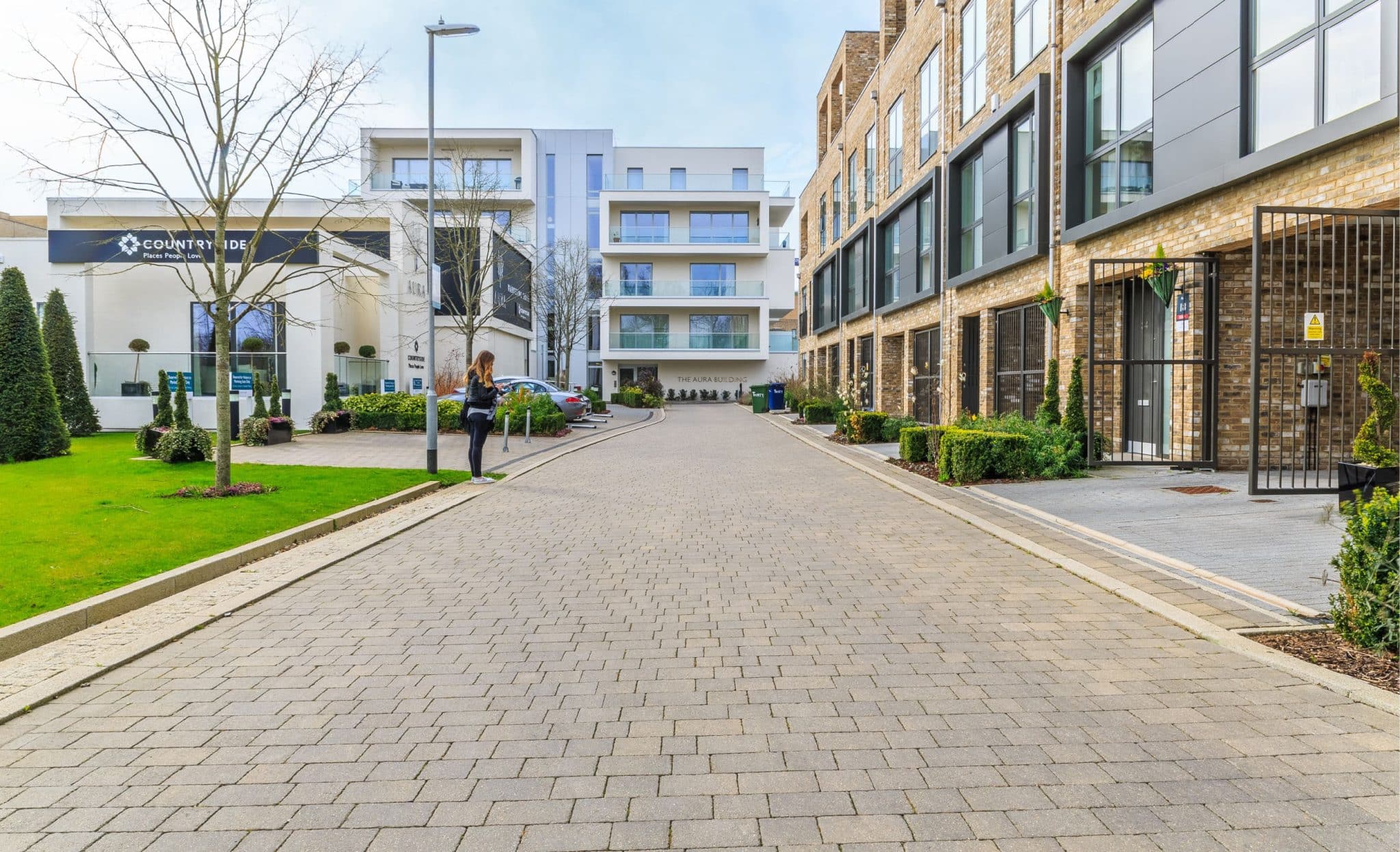
When designing access routes for emergency vehicles with permeable paving, the final surface must be able to support the expected loads imposed by emergency vehicles. The access road should also be of sufficient width and have a turning circle large enough to accommodate the emergency vehicles.
Approved Document B (Fire Safety) ‘Volume 1: Dwellings¹’ of the building regulations covers the provision and design of access routes for hardstandings. It states that they should comply with the guidance in Table 13.1.

The notes indicate that the roadbase can be designed to a 12.5 tonne capacity. This can be used to ensure that the permeable paving is designed to meet the correct traffic category.
The traffic categories for permeable paving are covered by British Standard: BS 7533-13 ‘Pavements constructed with clay, natural stone or concrete pavers – Guide for the design of permeable pavements constructed with concrete paving blocks and flags, natural stone slabs and setts and clay pavers’².
| Category / Application | Msa | Road Category | Application |
|---|---|---|---|
| 9 | ≤30 | 1 | • Adopted highways and commercial/industrial developments used by a high number of commercial vehicles |
| 8 | ≤10 | 2 | |
| 7 | ≤2.5 | 3 | |
| 6 | ≤0.5 | 4 | • Adopted highways and other roads used by a moderate number of commercial vehicles • Pedestrian areas subjected to regular overrun of commercial vehicles • Industrial premises • Petrol station forecourts |
| 5 | ≤0.05 | N/A | • Pedestrian areas subjected to occasional overrun of commercial vehicles • Car parks receiving occasional commercial vehicular traffic |
| 4 | ≤0.007 | N/A | • Urban footways with no planned vehicular overrun • Pedestrian areas used by light goods vehicles, emergency vehicles and maintenance vehicles |
| 3 | N/A | N/A | • Footways, pedestrian and cycle areas, domestic driveways or access routes subject to manoeuvring of cars and light goods vehicles • No access for other commercial vehicles |
| 2 | N/A | N/A | • Footways, pedestrian and cycle areas, parking spaces subject to cars and light goods vehicles • No access for other commercial vehicles |
| 1 | N/A | N/A | • Footpaths, pedestrian and cycle areas, excluding all vehicles |
The different types of permeable paving used in emergency vehicle access include plastic grids filled with gravel or turf, grass pavers, porous asphalt and permeable block paving.
Permeable paving solutions are usually deployed on sites with Sustainable Drainage Systems (SuDS) as they mimic natural drainage patterns. The rainwater is managed where it falls on a permeable surface rather than being directed off an impermeable surface in gulleys and drains.
As well as providing sustainable drainage, permeable paving solutions can create attractive and usable spaces. Permeable block paving provides developers with the option of using the same robust, hard-wearing solution for emergency vehicle access as is used on the rest of the site. This ensures design continuity as, unlike other options such as porous asphalt, permeable block paving is available in a range of colours and finishes to complement the overall site aesthetic.

Where projects require permeable surfaces as part of their SuDS strategy, two solutions frequently considered in the permeable paving design are permeable block paving or a porous asphalt surface. Both surfaces will work, however, as the comparison table below illustrates, permeable block paving offers a harder wearing, longer lasting and lower maintenance option to specifiers.
| Type of Permeable solution | Pros | Cons |
|---|---|---|
| Porous asphalt | • Quick to install • Lifetime of up to 20-years if correctly maintained | • Limited aesthetic benefit • Not as hard wearing as standard asphalt. More prone to clogging if not properly maintained |
| Permeable block paving | • Wide range of colours to complement project aesthetics • Hard wearing • Longer life span of up to 35-years lowers overall lifetime cost • Less prone to clogging will continue to function more effectively than porous asphalt if not properly maintained. | • Longer installation time • Higher initial cost |
A key advantage of permeable paving over traditional drainage systems is that its performance can be easily checked. Simply observing the surface during or after heavy rainfall to see if any areas of ponding have occurred can confirm whether it’s functioning properly.
Maintenance comprises of a bi-annual or post severely heavy rainfall visual inspection and a brushing or vacuuming of the joints and replacing any lost jointing material.
Here is a summary of the maintenance requirements of permeable block paving:
For extra reassurance about the long-term robustness of the drainage ability of permeable block paving, Research by Dr Sönke Borgwardt shows that even after 15 years without maintenance, permeable paving can still drain about 400 mm of water per hour — far exceeding the 100 mm per hour expected in extreme UK storms.
Our video case study revisits Rainey Endowed School, where Tobermore Hydropave permeable paving was installed in 2008–2009, to assess how the system has performed after more than a decade of daily use and minimal maintenance.
An on-site infiltration test evaluates how effectively the pavement continues to manage rainfall and demonstrates the long-term drainage capability of a SuDS-compliant permeable paving system.
Where sites consist mainly of impermeable paving, the project costs of specifying an alternative permeable solution for areas of the site, such as emergency vehicle access, will be carefully assessed.
However, comparing the cost of permeable block paving with that of a traditional impermeable surface, such as Tarmacadam, or Tarmac, should be evaluated by considering the whole construction process.
If only the cost of the top paved surface is considered, then the Tarmac will appear to be more cost effective than permeable block paving. However, the permeable surface drains any surface water between the joints in the blocks into the ground and can greatly reduce the need for items such as pipes, gulleys, manholes and drainage channels and reduces overall labour costs. When these extra drainage costs are included, permeable paving often proves to be the more cost-effective overall solution, as can be seen in this project costing example.

Tobermore has extensive experience in supplying permeable paving, and our technical team are on hand to offer advice on a wide variety of projects, including emergency access design.
Craig McBride, Tobermore’s Technical and Product Training Manager, explains, “We have extensive experience of helping our customers specify permeable block paving for all areas of a project, including those designing emergency vehicle access. Permeable paving offers a robust, cost effective and low maintenance surface that delivers a reliable long term sustainable drainage solution.”
At the technical design stage, our design partners can provide you with site-specific preliminary designs that show the suitable sub-base design requirements for our Hydropave product range. These tend to be sufficient for planning consent. This Permeable Paving Design is a complementary service which will save you time and money on site.

Request our complimentary permeable paving design to support you either in the design or construction stage of your project.