 Block Paving
 Paving Slabs
 Permeable Paving
 Retaining Walls
 Facing Bricks & Walling
 Kerbs & Edging
 Steps
0 products added
Products
Back


Yes, a segmental retaining wall can be extended below the water line in a wall-to-pond design. Segmental retaining walls are constructed from interlocking modular concrete blocks that are dry-stacked and do not require mortar. The combined weight of the concrete blocks and the soil reinforcement provided by geogrid layers allows the wall to retain ground effectively and prevent erosion.
The mortarless design of segmental retaining walls allows water to pass through the joints between the concrete blocks. This water typically originates from the surrounding ground and can drain through the structure. However, when a retaining wall extends below the water line, flow can also occur in the opposite direction. As a result, reinforced segmental retaining walls perform just as effectively in pond-adjacent applications as they do in open-air installations.
As we shall explore in this blog, the specification of segmental retaining walls remains the same whether the wall is retaining soil above ground or is partially submerged as part of a wall-to-pond design. Similarly, construction methods remain unchanged, offering the same benefits in terms of cost efficiency, installation speed and material availability. The performance and installation process are unaffected by whether the finished wall remains dry or is partially submerged.
No, the depth of the water does not affect the ability of a segmental retaining wall to retain the soil behind it. In applications such as attenuation ponds on housing developments, the maximum water level is typically shown on the project drawings so that the forces exerted by the water can be assessed during the design stage.
This does not present an issue when segmental retaining walls are correctly specified and constructed, as the design allows water to pass through the joints in either direction. In practice, the water pressure from the pond side actually helps to counterbalance the soil pressure acting on the opposite side of the wall. As a result, the presence of water can contribute to the overall stability of the structure where the wall is submerged.
The retaining wall will still be designed and reinforced using geogrid to account for the ground loads, in the same way as for a standard dry installation. This ensures that the wall would continue to perform effectively as a reinforced concrete retaining structure even if the pond were completely drained
No changes are required to the design or construction of segmental retaining walls when used in a wall-to-pond application. The drainage zone behind the concrete retaining wall will still consist of 10mm single size uncompacted drainage aggregate with a perforated drainage pipe of 150mm diameter wrapped in geotextile. The backfill zone will continue to use well-graded, compactable granular material and will be reinforced with geogrid in accordance with project-specific design recommendations based on the loads acting on the retaining wall.
Standard segmental construction suitable for retaining walls in wall-to-pond designs:
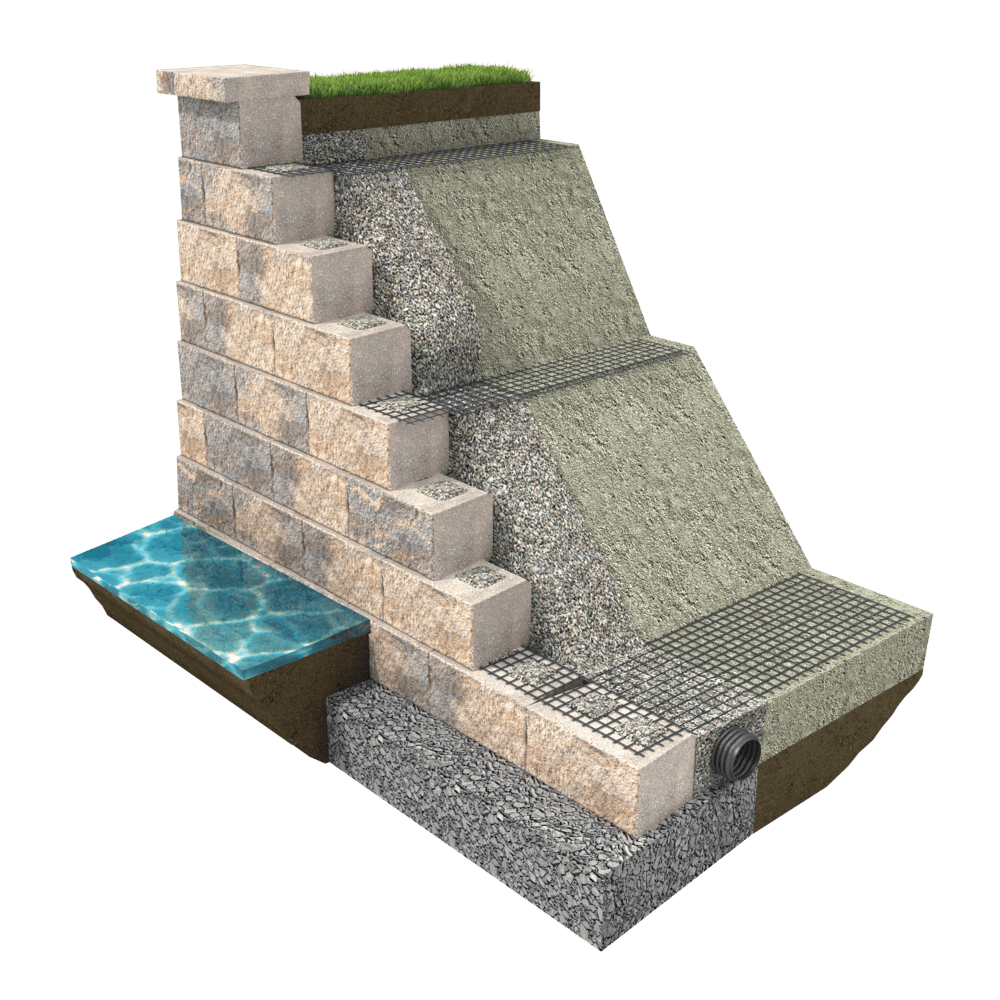
As a result, both the specification and construction of segmental retaining walls subjected to standing water are no different from those of a conventional above-ground retaining wall.
The structural integrity of a segmental retaining wall is not compromised by freezing water in a wall-to-pond application. As the concrete blocks are interlocked rather than bonded with mortar, there is sufficient tolerance for minor movement. This allows individual blocks, as well as those above and below, to accommodate expansion should water between the joints freeze.
Except during extreme cold conditions, any ice formation is likely to affect only a limited number of blocks at the water line. The remainder of the wall is able to absorb this movement without impacting overall performance. Even in the unlikely event that a concrete block cracked, it would not affect its overall compressive strength, allowing it to continue applying the downward load required to retain the soil behind the retaining wall.
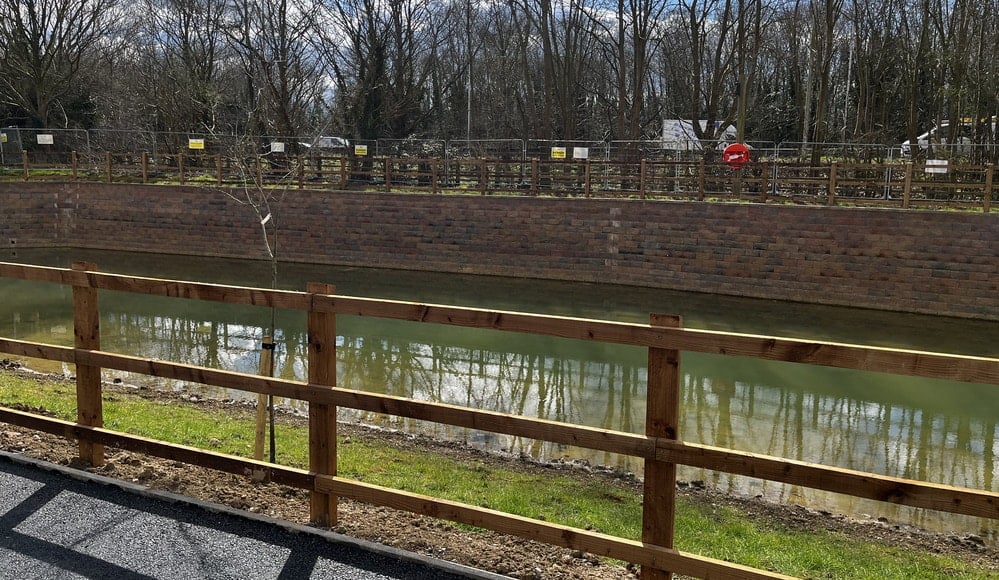
Tobermore has extensive expertise and experience in supplying our range of Secura Grand concrete segmental retaining wall blocks to meet a wide range of project requirements including those used in a wall-to-pond designs.
Alex Walther, Head of Technical Sales at Tobermore, comments about the flexibility of Secura Grand: “The mortar-free system and robust design of our segmental retaining wall solution make it straightforward to specify and install across a wide range of applications. The construction and design process remains the same whether the wall is installed above ground or partially submerged in water, making it an excellent solution wherever a retaining wall is required.”
Our Create and Construct support hub offers practical tools and support to help you plan and build with Tobermore products, from concept to completion.
Planning a wall-to-pond project? Contact our team for advice on choosing the right concrete retaining wall system for your site.

Our intuitive tools and dedicated team of retaining wall specialists are here to help at every step of your retaining wall journey.