 Block Paving
 Paving Slabs
 Permeable Paving
 Retaining Walls
 Facing Bricks & Walling
 Kerbs & Edging
 Steps
Steps
0 products added
Products
Back



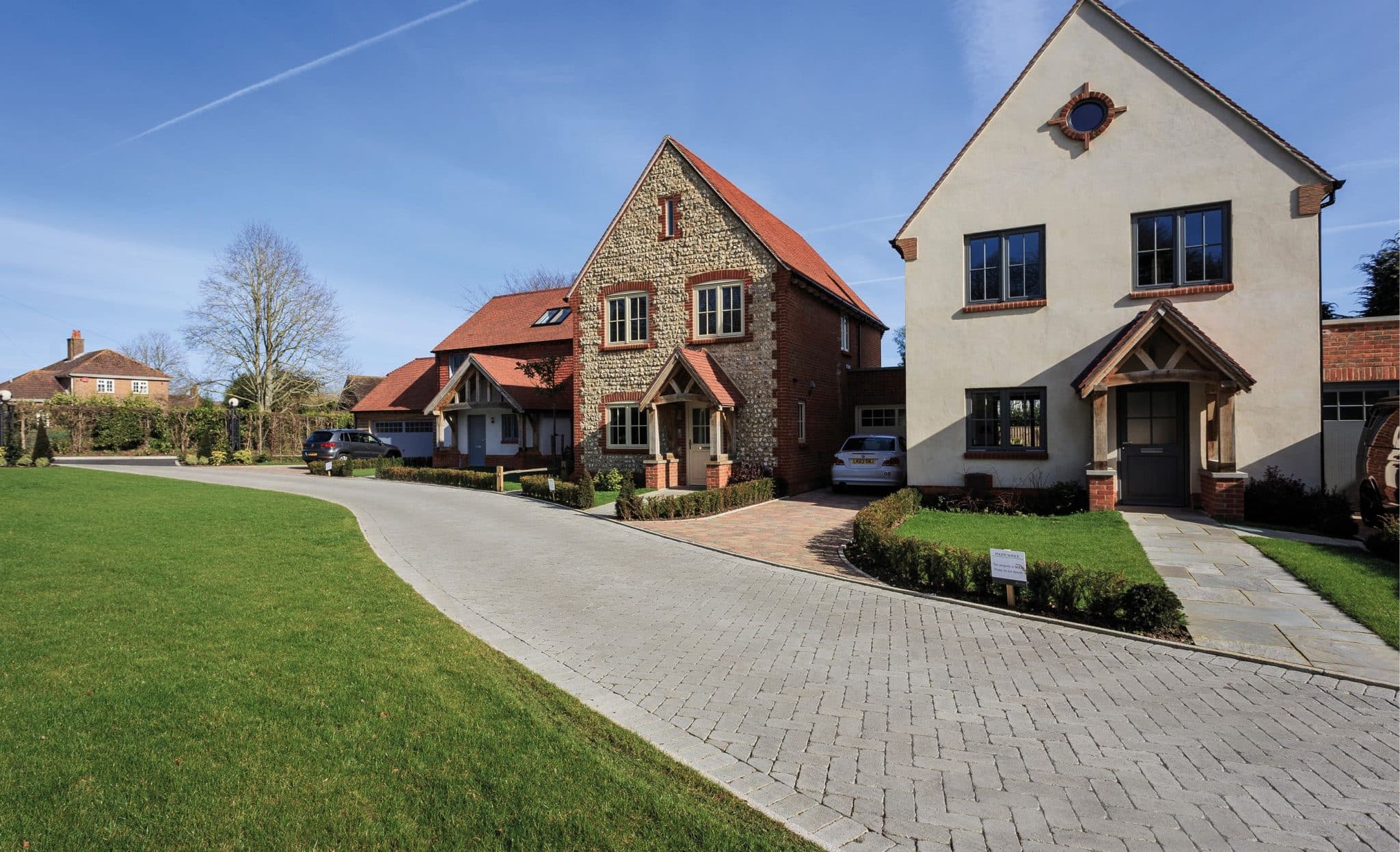
Both non-permeable paving and permeable paving can support the loading categories associated with access roads. The installation of both involves tasks such as ground excavation, preparing an appropriate sub base, and using suitable kerbing. This means specifiers need to focus on the drainage strategy being implemented on the project when deciding which paving is better for access roads.
If the access road on a housing development is adopted, the Local Authority (LA) plays a role in deciding how drainage will be implemented. The Flood Water Management Act encourages county councils to adopt Sustainable Drainage Systems (SuDS) for new developments and redevelopments. SuDS is focused on flood risk management by managing rainwater close to where it falls.
Non-permeable paving and permeable paving handle surface water in very different ways. Water falling on a non-permeable surface flows unfiltered via road gullies. It is then channelled away into the drainage system.
In contrast, permeable paving lets water drain through into the sub base beneath at the point at which it falls through joint filling material in paving joints.
Both non-permeable paving and permeable paving can be used on SuDS projects. However, permeable paving can often make the requirements of SuDS easier to achieve.
When compared to non-permeable paving, the way permeable paving provides drainage for access roads is better aligned with some of the key aims of SuDS, as the table below illustrates. This makes permeable paving better suited for access roads where SuDS is a requirement.
| Aim of SuDS | Permeable paving | Non-permeable paving |
|---|---|---|
| Manage rainwater close to where it falls. | The water drains through the joints between the permeable paving where it falls on the access road. | Water flows off the surface of non-permeable paving and is transported away via drainage gullies and channels. |
| Store runoff and release it slowly – known as ‘attenuation’. | Water gently filters into the sub base before being slowly released. | Water is diverted away quickly into the drainage system. |
| Allow rainwater to soak into the ground through infiltration. | Water soaks into the ground through infiltration via the sub base. | Water goes into the drains to be stored on-site in attenuation tanks, ponds and basins. |
| Slowly transport water on the surface to reduce risks to drivers on access roads. | Water quickly drains through the joints in permeable paving, leaving slow moving water on the surface. | Non-permeable paving transports the water quickly across the surface of the access road into the drains. |
| Filter out pollutants. | Permeable paving breaks down organic pollutants through naturally occurring micro-organisms in the sub base. | Pollutants are carried in the surface water into the drainage system. |
| Allow sediments to settle. | The rate of infiltration is controlled to allow sediments to settle. | Sediments are carried into the drainage systems and can cause blockages if not maintained. |

Tobermore’s Hydropave permeable paving range allows you to create spectacular hard landscaping features with environmentally friendly products.
At the moment, developers have the right to connect new sites to existing drainage networks without restriction. The potential upcoming implementation of Schedule 3 of the Flood Water Management Act would impose that this connection could only happen if SuDS have been incorporated. Local authorities (Las) would be designated as SuDS Approval Bodies (SABs). They would be responsible for approving all SuDS on new developments and maintaining any SuDS that are adopted in the future.
Adding further pressure on the government, the CCC (Committee on Climate Change) gives this clear recommendation in their report, UK Housing Fit for the future:
“The automatic right to connect new development to the existing sewerage network should be made conditional on national SuDS standards being met or by water company agreement.”
If Schedule 3 is fully adopted by the government, it’s likely to increase the use of permeable paving on access roads. This is because SuDS will be required by LAs who will be the SuDS Approval Body.
Local authorities also have guidance documents in the form of Design Guides or Toolkits. These can affect the specification of non-permeable paving and permeable paving.
The content of the guidance documents will differ based on the local area and the LA’s design strategy. However, one of the common themes is that products should be durable as well as easy to clean and maintain in the medium to long term.
Roads with non-permeable paving require regular cleaning to maintain drainage efficiency. Gullies will lose around 75% of their efficiency when the sediment level approaches the maximum before it blocks completely.
Permeable paving – with its ability to filter out pollutants and allow sediment to settle – requires less maintenance. It will remain effective and not flood, even if it gets to a level of being 90% clogged.
Both non-permeable paving and permeable paving offer robust surfaces to access roads. Non-permeable paving, pending a specification check with the LA, can form part of an effective drainage system where budget is a concern. This is as long as regular cleaning and maintenance takes place.
However, even without maintenance for 15 years, permeable paving can still drain water effectively through its joints—up to 400 mm/hour per m², four times more than the volume that occurs in extreme storms. This gives extra peace of mind to LAs that the access roads with permeable paving will continue to play their part in the SuDS strategy in the long term.

Tobermore has a range of non-permeable paving and permeable paving to suit the access road requirements of local authorities.
Craig McBride, Tobermore’s Technical and Product Training Manager, comments:
“We have a range of paving that can deliver either a non-permeable or permeable surface for access roads. Both types are robust and available in a variety of colours and appearances. We find that our permeable paving provides specifiers with an excellent way to include access roads in their overall plans to deliver a stunning and long-lasting sustainable drainage solution.”
If you have a project that will require a permeable solution for access roads, you can find help via our Permeable Paving Design service. This is complimentary and can save you time and money on-site by providing you with site-specific prelim designs.

Request our complimentary permeable paving design to support you either in the design or construction stage of your project.