 Block Paving
 Paving Slabs
 Permeable Paving
 Retaining Walls
 Facing Bricks & Walling
 Kerbs & Edging
 Steps
Steps
0 products added
Products
Back



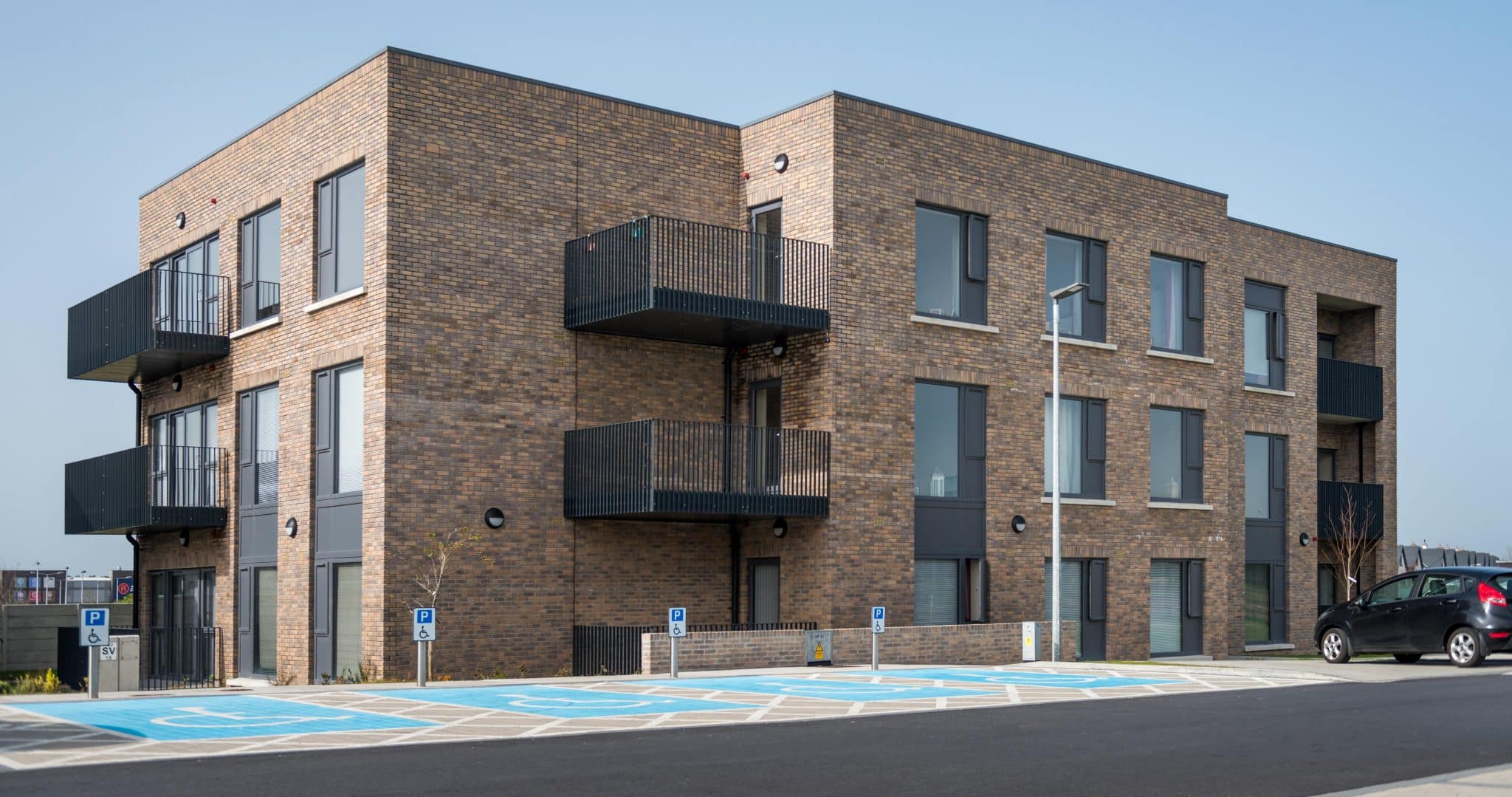
Concrete facing bricks are fire rated – they achieve the highest possible Euroclass fire resistance classification of A1 when tested in accordance with EN13501-1 ‘Fire classification of construction products and building elements – Classification using data from reaction to fire tests’¹. The A1 rating means that concrete facing bricks are classed ‘non-combustible’ and do not contribute to the development of a fire.
Most construction materials and products can be tested to gain a Euroclass reaction to fire classification. The Euroclass ratings range from A1 (non-combustible), being the highest, to F (easily flammable), being the lowest rating.
As you can see from the table below, there are various tests that can be used to determine the reaction to fire of the material being tested. The most stringent and difficult to pass is the EN ISO 1182 – ‘Reaction to fire for building products – Non-combustibility test’².
Concrete facing bricks have passed this EN ISO 1182 test. They do not contribute at any stage of a fire, are classed as A1 and therefore do not need to undergo any other tests listed at the top of the table.
Any construction products that achieve Euroclass ratings of B through to F are classed as combustible. Combustible products may face restrictions on their use under building regulations in England, such as Approved Document B (Fire Safety)³. Non-combustible concrete facing bricks do not face any such restrictions.


The fire resistance of concrete facing bricks is tested when they are part of a system. Concrete facing bricks are used with mortar to form a concrete facing brick wall, then tested to determine their fire resistance.
Fire resistance measures the ability of the components of a system to resist fire for a stated time period. Resistance times are quoted for:
The resistance to collapse applies to loadbearing elements only.
The resistance to fire penetration.
Resistance to the transfer of heat.
Fire resistance information for masonry walls was originally available in standard BS 5628-3. This was withdrawn in March 2010 and replaced by Eurocode 6 – Design of masonry structures – Part 1-1: ‘General rules for reinforced and unreinforced masonry structures⁴.’’ This standard includes information for designers on the passive fire resistance of concrete facing bricks used in masonry walls. It includes:
In both cases, fire resistance times of up to 4 hours can be achieved when using concrete facing bricks. In other words, concrete facing bricks can withstand four hours of fire without damage to their structural integrity. This gives specifiers the cost-effective option of using concrete facing bricks to achieve the same fire resistance and other performance criteria such as compressive strength and frost resistance offered by clay bricks.
Concrete facing bricks are either readily available from stock or can be ordered on short lead times and are available in a range of colours and finishes making them able to meet a broad range of project specification requirements in both form and function.

Tobermore has a range of concrete facing bricks, including Kingston and Lansdowne facing bricks, as well as Country Stone in our walling range. All have achieved a Euroclass rating of A1 and are classified as non-combustible.
Craig McBride, Tobermore’s Technical and Product Training Manager, comments: “With the increased focus on the combustibility of construction products, customers can use our concrete facing bricks with the reassurance that they are using products with excellent fire resisting properties. Being A1 rated for reaction to fire and classed as non-combustible simplifies compliance with the fire safety requirements of the building regulations. The fact that they can provide excellent fire resistance to buildings adds extra peace of mind to both developers and the residents of properties using concrete facing bricks.”
If you have a project and would like to test our range of concrete facing bricks, you can request a free ‘Sample brick wall’ of 60 facing bricks delivered to your site or use our Virtual Sample Studio to see how aesthetics and function can be balanced.
If you have any questions on any aspect of our concrete facing bricks, please contact our technical team who will be happy to help.

A single brick never tells the full story. This service allows housebuilders to request 60 of our concrete facing bricks to be delivered to site, enabling you to build a small-scale facing brick wall and giving you a better vision of how our concrete facing bricks would look on your projects.